Writing Modules For Cairn
Writing adventures for Cairn is very similar to writing for other OSR systems, with a few additional tweaks. Before reading further, see my previous post for a decent foundation on OSR module design. I’ve also written a guide on building a forestcrawl that applies many of these same principles.
I'll probably update this post going forward, so be sure to check back in!
Turns and the Dungeon Exploration Cycle
Exploring dungeons in Cairn is much like any other old school system, with extant procedures and a distinct culture of play. But there are a few differences I felt worth pointing out here.
First, make sure you've thoroughly read through the rules and procedures for dungeon exploration in Cairn.
Turns in Cairn are when a character moves (around 40ft) and performs one action. Turns happen contemporaneously, and can stack. When describing how long it takes to do something on a character's turn, think in terms of effort, not time.
A Dungeon Cycle is the span of turns in which each PC acts once. After every PC has taken a turn, the next cycle begins.
To illustrate the difference, imagine that the party is in a room filled with boulders. The text says that it takes 4 Turns of effort to move them all. That means that four PCs could move them in a single Dungeon Cycle.
Meanwhile, the party might need to walk over a thick stone bridge to get across a deep chasm. The text says that it will take a complete dungeon cycle to cross, regardless of how many PCs there are.
Sprucing up the Dungeon Events Table
In Cairn 2e, the standard exploration procedure for dungeons invokes a Dungeon Event roll only under the following conditions; when the party:
- Spends more than one dungeon cycle in a single room or location
- Moves quickly or haphazardly through a room
- Moves into a new area, level, or zone
- Creates a loud disturbance
These triggers are already present in the Player's Guide, so you don't necessarily have to highlight that the dungeon event die is rolled if they occur! If a trap makes a loud noise, it should be obvious to the reader that it triggers an event.
Some have found the terms "area, level, or zone" confusing; this is understandable. I will say this definitively here: a dungeon event roll is not triggered by the party walking into a new room.
Here is a quick primer on the differences:
- Area: A fundamentally new place. If the PCs enter a portal that drops them in a cave, for example.
- Level: This is in regards to elevation. Floor 1, Basement, etc. This one is pretty obvious.
- Zone: A zone is a marker for a part of a single dungeon floor. Each zone might have a unique faction, weather system, magic rules, and so on.
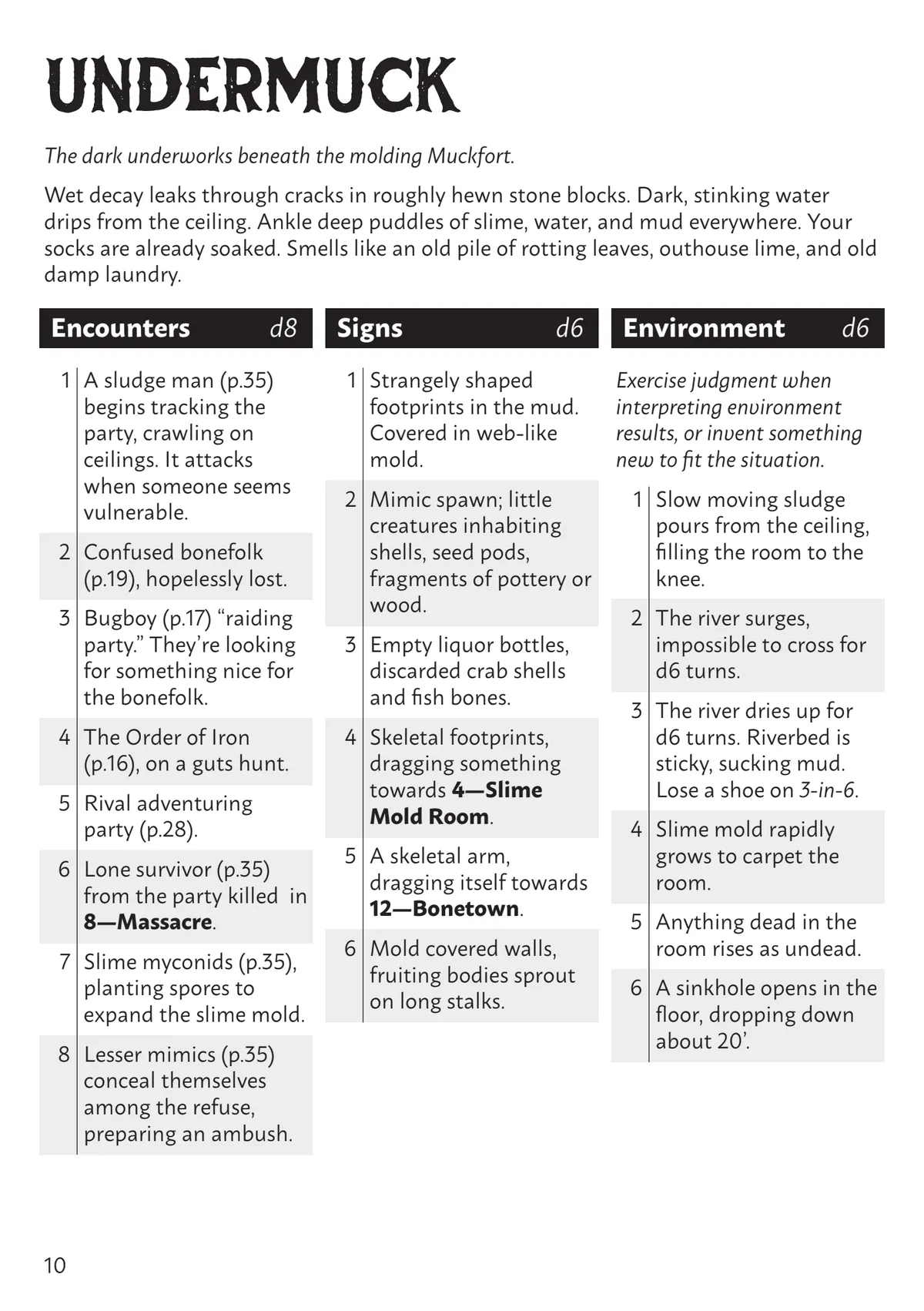
Try to give your dungeon a little more flavor by adding unique Encounter, Signs, Loss, and Environment results! This can really bring out the uniqueness of your location while also helping Wardens to come up with "What happens on a roll?"
One of my favorite examples of this can be found in Beneath the Muckfort by Bo Ryan Crum. See the following image for an example (posted with the permission of the author). Spoilers for that adventure if you haven't played it yet!
Saves
There are no “checks” in Cairn. Only Saves - you aren’t checking to see if someone can do something, you are saving to avoid whatever negative outcome or consequence might occur. Most dangers will be met by having the PCs Save against one or more Attributes (STR, DEX, or WIL).
When creating dangerous areas, don't think about obstacles, traps, or monsters as a means to test the party's skills. Instead think of what pressures are affecting the players in any given situation: the proximity to danger they are in. In Cairn, a character doesn't Save to pick a lock. They Save to pick a lock before the guard on patrol shows up. If there is no danger, there is no dice roll - they just succeed.
As an example, imagine you are designing a blocked corridor with a difficult obstacle to climb, like a sheer wall. In a game like Shadowdark, that would look like this:
Sheer Wall: A smooth, 30 ft wall. Climbing requires a Strength check (DC 12). On a failure, the character falls. With rope and grapnel, no check is required.
But in Cairn, there is no such thing as a check. And if there is no danger, there is no Save! That means that the relevant bullet would look like this:
Sheer Wall: A smooth, 30 ft wall. Cannot be climbed without the proper tools.
But let's assume you are creating a dangerous encounter, like a locked door with a hidden poison gas trap. Again that might look like this in Shadowdark:
A narrow stone chamber ends in a heavy oak door bound in black iron. The air here smells faintly bitter.
- Door: Locked (DC 12 Dexterity check to pick).
- The bitter smell is from a poison gas trap hidden in the lock. If the trap is triggered, a burst of poison gas fills the immediate area. Creatures nearby must make a Constitution save (DC 12) or take damage and become paralyzed.
Here, there is a check to see whether a PC will succeed at picking the lock, as well as a check to disarm the trap without triggering it. I will note that the Shadowdark rulebook explicitly calls out the fact that if a PC has the time and means they simply succeed. That's really cool!
In Cairn that same trap would look like:
A narrow stone chamber ends in a heavy oak door bound in black iron. The air here smells faintly bitter.
- Door: Locked. The bitter smell is from a poison gas trap hidden in the lock.
- If the trap is not disarmed, tampering with the lock releases a cloud of poison gas dealing d6 DEX damage to anyone in the room, and the person nearest to the door cannot avoid the gas.
You'll note that there is only one roll in this example. We are only interested in the danger facing the PCs. It is assumed that given proper tools, skill, and time the PC will succeed.
You also don't always need to tell the Warden which Attribute (or mechanic) the PCs will need. You can simply allow the Warden (and players) to come up with the best ruling to avoid the danger at hand.
Difficulty
Disadvantage happens in the fiction, rather than through mechanics. There is a chapter on this in the Warden’s Guide, but in short: the Warden is expected to modify the outcome according to the effort that went into accomplishing the task, the risk involved, what skills or abilities were in play, and so on.
If you are REALLY keen on disadvantage, you could say something like “wearing armor makes it impossible or requires a Save” or “only X type of people can retrieve it.”
See Variable Difficulty in the Warden's Guide for more.
Perception
There are no Wisdom, Perception or Intelligence checks in Cairn. That means you would never test whether a PC can detect something; they can reasonably perceive whatever a smart person would be able to notice. Anything hidden is revealed when a PC spends their turn investigating something. If they fail to do that, they miss it. You can read more about Knowledge & Perception in the Warden's Guide.
Traps
Traps should present the PCs with an interesting decision to make, and punishing PCs for simply stepping into a room doesn't make for interesting play. All traps should have a "tell" that indicates their existence, even if it isn't immediately obvious.
Chance
Stick to a simple x-in-6 for dealing with chance. It's OK to explain this in the module for those that aren't familiar, and it's much easier to understand "Roll a d6, on a 2 or lower this happens" than explaining what happens on a 1-in-3 chance.
Number Appearing
Don't assign a random number of monsters to a location. Be specific; let the Warden know exactly what you designed this place to be like!
Backgrounds
It can be helpful to create some custom backgrounds for your module or supplement. It's easy, and fun! First, read the chapter on creating backgrounds in the Warden's Guide. Additionally, I have some tips!
- Add items for each background table result. They can be mundane! If you’re looking for some to steal, see here or here.
- I tend to shy away from magic-heavy backgrounds, as they get OP real fast.
- Get weird with it!
Bonds
Bonds are mini stories written in the second person that tie a character's history to the setting. They are not bound to a specific background, and offer only one potential path forward out of many. A good Bond will typically provide a PC with a starting item (usually petty) or perhaps a unique feature (but rarely both). For example:
As a child, you found a strange book in an alley. The language is alien, and thus far none have been able to read it. Sometimes, the pages rearrange themselves. Recently, some of the symbols have become more clear. They are a warning.
The PC would add "Strange Book" to their inventory, and it's up to the PC (and probably, the GM) to figure out how to use that in the future.
And another with no starting items attached:
You created a potion to destroy the memory of something important. You do not remember what is was, or why you did it. You are left with only a feeling of dread.
Omens
Omens are much like Bonds but are less specifically tied to an individual. They are written in the third person, and always bode ill for someone, whether an individual, a town, the Wood, the entire setting. They often feature natural elements (stars, livestock, insects, and so on), but only hint and something terrible happening in the future.